Showing posts with label scribe. Show all posts

Tuesday, April 8, 2008

Mariya's 2nd Scribe

Today, Mr. Harbeck gave us an assignment to make nets on 1 cm grid paper. We had 6 shapes to do. What we did was that we took a couple of units and measured the sides of the 3 dimensional shapes. We measured the height, length and width. After measuring the sides, we drew a net. The net had to make a square with 6 sides. After making the net, we did the area of the sides.

My assignment for this scribe was to show you three of the six shapes that we did in class.


Jenna's Scribe Post

Today in class we found the surface area for different squares/rectangles.


#1:


#2:


#3:

Saturday, March 15, 2008

Angelo's Scribe

Mr. Jerema is teaching us , and he introduced "Pythagoras" to us. We learned that a triangle can also be a right angle.
We first learned about the three basic angles. He showed us that a circle has a 360º angle. If we cut the circle in half it will be 360 divided by 2 and it will turn into a 180º angle, also known as a straight angle. If we cut the semi - circle in half, it will be 180 divided by 2 and it will turn into a 90º angle, also known as a "right angle."


So if we make a right angle and then add the extra line to make it a triangle, it will make a "right angle triangle." In a right angle triangle, there are two legs and a hypotenuse. The legs are the two lines to make a right angle, and the hypotenuse is the longest line.The legs can also be labeled "a" and "b." The hypotenuse will always be a "c."


To find the area of a rectangle, you would have to multiply the length (a) and width (b) together. But if you want to find half of the area, it has to be Length(a) times Width(b) divided by two. If you want, you could also cut the rectangle in a triangular way (it will be the same thing).

Wednesday, January 30, 2008

Angelo's scribe

Today, Mr Harbeck was away (AWWWWWWWWWWW) so we just did fraction word problems.
I'll show you how I did three of them:


Explanation1: I needed to find out 3/8 of 24, so i first divided 8 to 24. The answer was 3, and that meant 3 is 1/8 of 24. So, to get 3/8 i had to times 1/8 three times. That's why i did 3 times 3.


Explanation2: I needed to find out 3/5 of 125, so i first divided 5 into 125. The answer was 25, and that meant 25 is 1/5 of 125. So, to get 3/5 i had to times 1/5 three times. That's why i did 25 times 3.


Explanation3: I needed to find 7/8 of 160, so i first divided 8 into 160. The answer was 20, and that meant 20 is 1/8 of 160. So, to get 7/8 i had to times 1/8 seven times. That's why i did 20 times 7.

This is how I did my questions. Hope you guys agree!

Tuesday, January 22, 2008

Anne's Scribe

Today we learned about multiplying fractions. We made a pamphlet yesterday and filled in boxes. In one particular box we talked about Standard Algorithim and Array Models to help us multiply fractions easier and with better understanding.

In that box we learned about making ugly fractions into friendly fractions. How to do that was to take an ugly fraction (for example) 20/33 x 11/30. Those are what you can call ugly fractions! To make it easier for you and other people, you can just do a numerator swap (as Mr. Harbeck says) with the 20 and 11. So now your fraction is 11/33 x 20/30.

Now you can simplify both fractions. 11/33 can be simplified into 1/3 because 33 can be divided by 11, and 11 can be divided by 11. Or, 11 can fit into 33, 3 times. Or another way to show that it can be changed into 1/3 is because 11 and 33 is divisble by 11. 20/30 can be simplified into 2/3 because they are both divisible by 10. 10 fits into 20, 2 times. 10 fits into 30, 3 times. How hard was that?!

Now the final step is to get both fractions and multiply them. Now you are ended up with a much more easier and pretty fraction. Get ready for extreme multiply makeover! 1/3 (11/30) x 2/3 (20/30). Since we already talked about multiplying fractions by using cross multiplying we can now get a fraction without having to multiply large, ugly numbers. Wasn't that easy?!


click for a picture http://www.freewebs.com/annev/math.JPG

Wednesday, January 16, 2008

Mariya's Scribe

today, we learned about adding fractions.
mr harbeck showed us how to add fractions with an example. our example was 4/5 + 8/15. we knew that 4/5 + 8/15 didnt equal to 12/20. so, what we did was find a common denominator. so, 4/5 became 12/15. what we did to get 12/15 was that we multiplied 4/5 by 3. now, we can add the two fractions. so, 12/15 + 8/15 added up to 20/15. 20/15 is an unpropper fraction so we changed it to 1 5/15 or simplified it to 1 1/3.


today, we also did another investigation. in today's investigation, we are doing a problem in two places in Brooklyn, Carrol Garden and Flatbush. what we know about the two places is that the community wants to build a park for their neighbourhood and both of their space for the park is 50 m by 100 m.
In Carrol Garden's, 3/4 of the lot is devoted to a playground and 2/5 of the playground is blacktop.
In Flatbush, 2/5 of the lot is devoted to a playground and 3/4 of the playground is blacktop.

these are our questions.
- is one neighbourhood getting more blacktop than the other?
- is there more blacktop space in one lot than in the other lot ?
- how would you convince the people in the two neighbourhoods that your conclusion is correct ?

Sunday, January 13, 2008

Karen's Scribe

Last Friday in class we did a test about adding and subtracting fractions.
I will be explaining two questions from the test. The following questions will be #'s 3&4.
Question #3

To find the answer I used $ strategy. First I ignored the 5 from 5 9/10 then I have to figure out the answer for 9/10 using 100, so then it would be 100÷10(denominator)=10 multiply by 9(numerator) equals 9o it would be 90/100. Next is 3 4/5 again I ignored 3 so then for now we have 4/5, 100 divided by 5 is 20 multiply by 4 is equals 80/100.

Now we have 10/100, we still have 5 and 3 that we ignored previously. I just did 5-3 = 2 then included 2 to the answer


Question #4

Using the $ money strategy. I did kind of the same thing for the question #3 that I just answered previously. I also ignored the whole for each fraction so then for now I have 2/5 and 13/20

But since you can't subtract 40/100 to 65/100. Now I have to take the whole from 5 9/10 to subtract it to 1 ( 5-1) = 4 then I add 40 + 100 since we have 40/100 I added them together so it became 140/100for 3 65/100 I just leave it the same way then now we have 4 140/100 subtract by 3 65/100 = 1 75/100 although we can still simplify it.

I simplified 75/100 divided by 5 = 15/20 then again divided by 5 = 3/4 then that's where I added 1 to get 1 3/4


Tuesday, January 8, 2008

Angelo's Scribe

Today in class we learned different strategies to solve addition fractions. The three startegies were using clocks, money, and double number line ( also called Common Denominators).

We first startegy we did was clocks. We found out that the magic number for clocks was 60 minutes. After that, we figured out the numbers that would divide evenly into 60. They were 2, 3, 4, 5, 6, 10 , 12, 15, 20, 30, and 60. We did an exmaple question and this is how I solved it.
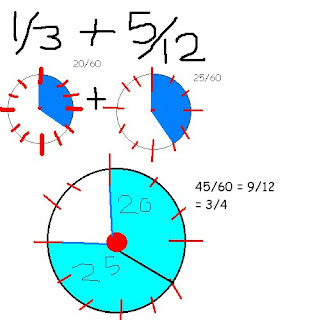


1/3 is 20 mintues on a clock. 1/12 is 5 minutes on a clock, but since it's 5/12 we just have to multiply 5 minutes, 5 times. This will get us 25 minutes. Add it together and get 45 minutes over 60 minutes. You could reduce it to 9/12. Reduce it one more time and get the final answer, 3/4

The second startegy we did was money. We found out the magic number for money and it was 100. After that , we figured out that 2, 4, 5, 10, 20, 25, 50 and 100 were the numbers that divide into 100 evenly. We did an example qeustion and this is how I
solved it.


The first number 3/10 was easy to solve , because the denominator, 10, meant that it was in dimes. SO all we had to do was multiply 3 by 10 and it equaled 30 cents over 100. The second number was easy to solve, because the denominator, 20, meant that it was in nickels. So all we had to do was multiply 9 by 5 and it equaled 45 cents over 100. Add that together and get 75 cents over 100. You might see it kind of looks like three quarters. So the final answer is 3/4.

The last strategy we did was double number lines. We found out that any number can go into it. We did an example question and this is how i did it.


Since 5/8 equals 55/88, by just multiplying 5 and 8 with 11.
3/11 equals 24/88, by just multiplying 3 and 11 by 8.
the number line was up to 88 since that was the denominator. we first did 3/11 (24/88) and added 5/8 ( 55/88) which equalled to 79/88.

This ends todays math class! Remember to finish your math homework.

Clock:
1/2 + 3/10
4/5 + 1/12
1/3 + 11/20

Money:
5/20 + 1/10
2/4 + 10/25
17/50 + 2/5

Double Number Line:
6/13 + 2/5
1/4 + 6/8
12/19 + 1/3