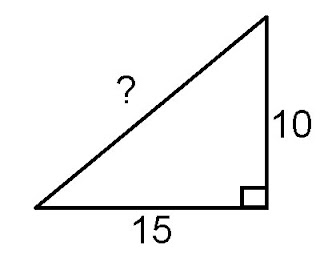
You've just picked up a ground ball at first base, and you see the other team's player running towards third base. how far do you have to throw the ball to get it from first base to third base and throw the runner out?
Question 4 * --
The house is 10mh high. Joshua is standing 11m away from the house. How far does he have to throw the snowball to get it on the roof?
A Pythagorean Triple is a right triangle that uses a set of numbers (1, 2, 3, etc) that satisfy a2 + b2 = c2. (no decimals) <--- This is a Pythagorean triple. You can label each leg A or B, it doesn't matter which, but the hypotenuse is always labelled as C. (you can tell which is the hypotenuse because it is always opposite the right angle)
You can then place the numbers where the letters are. ( use numbers from perfect square chart )
Part 2: BubbleShare: Share photos - Powered by BubbleShare
Part 3:
You've just picked up a ground ball at first base, and you see the other team's player runnig towards thrid base.
How far do you have to throw the ball to get it from first base to thrid base, and runner out?
Part 4:
Mrs. Claire tells you that a right triangle has a hypotenuse of 13 and a leg of 5. She asks you to find the other leg of the triangle. What is your answer?
A Pythagorean Triple is a right triangle that uses a set of whole numbers (1, 2, 3, etc..) used to satisfy the problem a² + b² = c².
The example im going to use is 3² + 4² = 5². There are other triples as well, like 6² + 8² = 10².
Part 2 :
Part 3 :
You're locked out of your house and the only open window is on the second floor, 25 feet above the ground. You need to borrow a ladder from one of your neighbors. There's a bush along the edge of the house, so you'll have to place the ladder 10 feet from the house. What length of ladder do you need to reach the window?
Part 4 :
If you needed to throw a waterballon up onto rooftop thats 10 meters tall, and you were 15 meters away how high and how far would you have to throw the waterballoon?
Part1: A Pythagorean Theorem is when the legs of a right triangle ( a & b ) and the hypotenuse obey the following relationship " a2 + b2 = C2." A Pythagorean Triple is a right triangle that uses a set of numbers (1,2,3,etc...) that satisfy a2 + b2 = C2. The set of numbers can't have any decimals For example, 3squared + 4squared = 5squared.Another way to say that is, 9 + 16 = 25. I had to figure out another Pythagorean Triple using only the Perfect Squares up to ten. The perfect squares are: 1 x 1 = 1 2 x 2 = 4 3 x 3 = 9 4 x 4 = 16 5 x 5 = 25 6 x 6 = 36 7 x 7 = 49 8 x 8 = 64 9 x 9 = 81 10 x 10 = 100 The next Pythagorean Theorem after 3 squared + 4 squared = 5 squared is, 6 squared + 8 squared = 10 squared. I proved it in three different visual ways. The first one I used the right triangle. It is clear that the legs will add up to the hypotenuse. The second way, i proved it in squares. It is clear that 36 squares (6 squared) + 64 squares (8 squared) will equal 100 squares (10 squared). The third way, I showed it in squares again. You could see that the a2 and b2 fits in c2 perfectly.
Part 2: BubbleShare: Share photos - Powered by BubbleShare
For the missing hypotenuse, I first wrote down what i knew then began the Pythagorean Theorem. In using the squares, 10 was my Whole Number because it is the the closest perfect square before the number 117. I then got my Denominator by subtracting the two perfect squares from eachother. I got the numeratoe by subtracting the main number and the smaller perfect square. I couldn't end my answer with a Mixed fraction so I divided 17 to 21 to came up with a decimal form.
For the missing leg B I did the similar steps like the missing hypotenuse, but it changed when it came to the subtracting part. To get "B" you had to subtract A from C. After those steps you were back to the normal "missing side" steps.
For the missing leg A it was the same as Missing side B. The square is just in a different position during the subtracting steps.
Part 3:
Before I could do the Pythagorean Theorem, I first had to write down what I knew. The height of the frog from the tongue is 70 cm ( there is 100 cm in a m). The height of the door was 2m. And the distance from Lefrog and the door was 1.5 m. But I couldn't make a triangle just with that information. I had to find out what the height of the door is starting from the height of the tongue. So I had to subtract 70 from 200 which made 130cm or 1.3m. From there, I had my A (1.3) and my B (1.5). That's when I could use those numbers and the Pythagorean Theorem to solve the answer.
Part 4:
BubbleShare: Share photos - Powered by BubbleShare
Just in case you guys can't read the question. It says, " Mary had a dream to dunk. So one day she attempted. She stood at the free throw line, which was 20 feet away from the net. The basketball net's height is 10 feet tall. Mary is 4 feet tall for her feet to her arms. Her arms has a reach of 1 feet. How far and high does she have to jump to SLAM DUNK???
Answer: First you had to write down what you knew. After that you had to make the triangle with the starting lengths. I subtracted 4 from 10 to get the starting height(A). I subtracted 1 from 20 to get the starting distance(B). Once I got those facts, I could finally do the Pythagorean Theorem. After I get the number for C², I could use the squares and get the Mixed Fraction. After that, I would just have to divide the Numerator to the Denominator, and add the answer to the Whole Number.
You are locked you of your house, the only way in is an open window on the second floor 25 feet above the ground. Youre going to borrow a ladder from one of your neighbours. There are bushes around house so you have to put the ladder 10 feet away from the wall. What length of the ladder do you need to get to the window?
Part IV:
Mr. Jerema tells you that a right triangle has a hypotenuse of 13 and a leg of 5. She asks you to find the other leg of the triangle. What is your answer?
Mr. Jerema is teaching us about the Pythagorean Threom in which it states that if you add both legs of the right triangle(which is labelled a and b) is equal to the hypotenuse(which is labelled c) of the right triangle. (a squared + b squared= c squared.) This is how a Pythagorean theorem looks like:
To test if this theorem is right he taught us the Pythagorean Triple in which it uses a set of numbers (1,2,3,etc.). The numbers indicate the perfect squares which means there's no decimal used. For example: 3 squared + 4 squared= 5 squared
(9 + 16= 25)
a= 3 squared b= 4 squared
c= 5 squared
3 squared= 9 4 squared= 16 5 squared= 25
But using another set of perfect square numbers we can test if this theorem really works. We could use the numbers 6 squared, 8 squared, and 10 squared.
(36 + 64=100)
a= 6 squared b= 8 squared
c= 10 squared
6 squared= 36
8 squared= 64 10 squared= 100
Part II:Find the Missing Side
To find the missing side of any right triangle always remember the pythagorean formula (a squared + b squared=c squared). From this formula you can formulate other formulas you could use in finding the sides of a right triangle, like the legs or the hypotenuse.
A. HYPOTENUSE: for finding thre hypotenuse use the original formula. Always remember to find the hypotenuse it is where thew right angle always points.
example BubbleShare: Share photos - Powered by BubbleShare
B. LEG(it's either a or b): write the original formula then formulate the formula you need for solving the problem. First thing is to write what you know to help you solve the problem.
example:BubbleShare: Share photos - Powered by BubbleShare
Part III: Word Problems
Example: You've just picked up a ground ball at first base, and you see the other team's player running towards the third base. How far do you have to throw the ball to get it from first base to third base, and throw the runner out?
Baseball Field Answer: you should throw the ball 127.28 ft far.
Part IV: Make your own Word Problem
Example: If you're climbing up a mountain whose height is 36 m high and the base is 10 m long across. How long would the slope be if you have to roll a ball down to the other side of the mountain from the top of it?
Part 1: Describe what a Pythagorean Triple is and use your perfect square chart from 1 squared to 10 squared to find another one other than 3,4,5. (Note: You need a picture, not simply text.)
The definition that Mr. Jerema gave us was: "A Pythagorean Triple is a right triangle that uses a set of whole numbers (1, 2, 3....etc) that satisfy A² + B² = C²"
A pythagorean Triple is a right triangle where the sides are in the ratio of a positive integer or whole number. Examples are] 3:4:5, 6:8:10, 5:12:13, 9:12:15, 8:15:17 etc. The formula is simple] a² + b² = c² OR x² + y² = z² You can invert that formula with the examples like this] 3² x 4² = 5²
perfect square chart 1 x 1 = 1 2 x 2 = 4 3 x 3 = 9 4 x 4 = 16 5 x 5 = 25 6 x 6 = 36 7 x 7 = 49 8 x 8 = 64 9 x 9 = 81 10 x 10 = 100
Part 2: Using embeddable web 2.0, describe how to find the missing side of a Right Triangle using the Pythagorean Theorem, show how to solve both for a missing leg and the hypotenuse (note: you may use numerical examples ie. a=4 b=6 c=?)
The first slides about the missing hypotenuse shows that the straight angle is 3 and the other straight angle is 4, is can be labelled either a or b. But let's say that a = 3 and b = 4. Now we have to find the missing side, since the right angle is in the bottom left corner, pretend to draw a little box to make sure that it is a right angle. Now if you can imagine the box, it would be pointing to the line.. which is the hypotenuse. We have to figure out what the hypotenuse is so we first: write down what we already know then write down the pythagorean thereom then transfer that into the squared numbers then transfer that into their standard form then add it together and you get the number but after you have to figure out the square unit for the number in this case, the number is 25, which is easy because the square unit is perfect since 5 squared = 25.
Part 3: Explain how to solve a Pythagoras word problem. Use one of the examples we covered in class (Worksheet A, B, LeFrog or Bonus Problem).
You've just picked up a ground ball at first base, and you see the other team's player runnig towards thrid base. How far do you have to throw the ball to get it from first base to thrid base, and runner out?
I highlighted half the square because it made a right triangle. Since all the sides are 90 squared except for the line running through third base and first base. That was the hypotenuse.
Part 4: Now that you have seen many Pythagorean problems, create your own word problem.
Two joggers run 8 miles north and then 5 miles west. What is the shortest distance, to the nearest tenth of a mile, they must travel to return to their starting point?
11/12=6/11+5/11=13miles+10 5/5 Miles= 23 5/5 Miles
The Whole Matters-
7/8 Both are using 26 miles.
11/12
Friendly Fractions-
1/8=3 1/4 Miles
7x1/8=7/8
7x3 1/4= 23 5/5
1/12= 2 1/5 Miles
11x1/12= 11/12
11x2 1/5= 23 5/5
How much pizza does each student get in the different groups?
In group 1 4 kids got 3 pieces of pizza each. In group 2 5 kids got 4 pieces each. In group 3 6 kids got 5 pieces each. In group 4 8 kids got 7 pizzas each. Which group gets the largest portion of pizza?
Group 4 got the largest portion. Show how you found your answer in 2 different ways.
I used a Ratio Table and Circles (Pizzas). Another way is I noticed... Group number 2 for example. 4 Pieces each. 5 kids 4 pizzas. Slices it 5 ways evenly (Look at the 5 kids). Then they got 4 each (Look at the 4 pizzas)
What strategies did you use in finding your answer.
1.) What strategies were needed? The strategies that were needed to solve this problem were the ratio table, division, and multiplication. I also used the clock method.
2.) How did you use the strategies? By using a ratio table or the clock method I could easily figure out how to get the price and the other information given on the test.For an example (on a ratio table): I took 2 2/5 cups then multiplied it by 5 to get 12 cups . I then did the same thing for the price. 2 2/5 cups was $3.60 so then you multiply that by 5 since you multiplied 12 by 5 then you get $18.00.
3.) Or how could you have used these strategies? You can use this strategy to find out the answers to other amounts for diffrent sized containers.
4.) How would you figure out the price of the 6 cup bag of Betty's Snack Mix? You can use a ratio table. Since we know that 2 2/5 x 5 is 12 and the price of 12 cups is $18.00. You now just divided 12 by 2 to get 6 then do the same thing with the price. Since we know that $18.00 is the price of 12 cups, you just divide 18 by 2 to get how much it is for 6 cups which would be $9.00
5.)Find other 3 values that could be solved sing the ratio table. Find the $$ of new container sizes.
Question 2
Question 3
Question 4
The last group with Paul, Alex, Chris, Jughead, Archie, Reggie, Mr. Wotherbee, Midge and they had 7 pizzas to share. That group had the largest portion of pizza, out of all the other groups of people.
Growing Post Question 1 Betty's Snack Mix Total (15 marks) 13/15 marks
Answers all questions 5 marks (1 per Question) 5/5 marks
Quality of Answers 10 marks 8/10 marks
Growing Post Question 2 (10 marks) 5/10 marks
Embeds the voicethread after question 1 (1 mark) 1/1 marks
Creates the Voicethread to answer Question (1 marks) 1/1 marks
Add Comments to further elaborate on the strategies used (1 per comment left) Max 4 marks 0/4 marks
Math work is correct in the voicethread (4 Marks) 3/4 marks
Bonus marks for any person doing more than 4 questions (2 marks)
Growing Post Question 3 (14 marks) 10.5/14 marks
Uses Pictures or a voicethread to answer the question (3.5 Marks) 3.5/3.5 marks
Explains the 7 strategies using 7/8 and 11/12 (7 Marks) 7/7 marks
Comments on the voicethread (3.5 marks .5 per comment) 0/3.5 marks
Question 4 Sharing Pizza's (15 marks) 11/15 marks
Clearly shows How much pizza does each student get in the different groups? (4 marks) 4/4 marks
Shows which group gets the largest portion of Pizza (2 marks) 2/2 marks
Show how you found your answer in 2 different ways. (4 marks) 4/4 marks
What strategies did you use in finding your answer. Student must show strategy and explain how it was used.(2 marks) 1/2 marks
Added comments on voicethread or added detail to explanations (3 marks) 0/3 marks
Total Math Work (54 marks)39.5/54 marks
Formatting (21 Marks) 19/21 marks
Proper title (2 Marks) 2/2 marks
Proper labels (3 marks) 3/3 marks
Only one post and no drafts left in dashboard (2 marks) 2/2 marks
Questions are in the proper order (4 Marks) 4/4 marks
Post looks pleasing (10 Marks) 9/10 marks
Pictures are lined up, text is left justified etcThe post looks professional and not piecemeal.Completing Self Evaluation and leaving a comment (10 Marks) 9/10 marks
Completing 2 Peer Evaluations Leaving comments on the Growing Post and Voicethreads (20 marks) 20/20 marks
-The strategies that were needed are a ratio table, dividing , and multyplying.
2.) How did you use these strategies?
-I used these strategies by using the information given on the test and putting it into a ratio table.
For example i used 2 2/5 cups then multiplied by 5 to get 12 cups . For the other side of the ratio table just do the same thing so the price of 2 2/5 cups was $3.60 so then you multiply that by 5 since you multiplied 12 by 5 then you get $18.00.
3.) Or how could you have used these strategies?
-You can use this strategy to find out the other cost's of different sized containers.
4.) How would you figure out the price of a 6 cup bag of Betty's Snack mix? Use a ratio table
5.) Find 3 other values (amounts of Snack Mix) that could be solved using the same ratio table. Find the $$ of your new container sizes.
1) What strategies were needed? - The strategies that I used to solve the test are ratio table, multiplication and division 2) How did you use these strategies? - I used this strategies by making a ratio table then divide them into half, the first half of it would be the cups while the other half would be the money ($). For Example : 3) Or How could you of used these strategies ? - You could use these strategies to find different answers 4) How would you figure out the price of the 6 cup bad of Betty's Snack Mix ? - Since 2 2/5 x5 is 12 for $18.00. I just divided 12 by 2 to get 6 then I did the same thing in the other side (x2) to get how much it is so then 6 cups would be $9.00 5) Find 3 other values (amounts of Snack Mix) that could be solved using the same ratio table. Find the $$ of your new container sizes. Here's what I did ..
#2
#3
#4
How much pizza does each student get in the different groups? group one each will get 3 slices of pizza group two each will get 4 slices of pizza group three each will get 5 slices of pizza group four each will get 7 slices of pizza
Which group gets the largest portion of pizza? - group4
Show how you found your answer in 2 different ways. - at the picture
What strategies did you use in finding your answer. I used a ration table, a picture and using money
Show your answer is 2 different ways. I would recommend that you create a voicethread of your work.
Self Evaluation: Growing Post Question 1 Betty's Snack Mix Total (13/15 marks)
Growing Post Question 2 (9/10 marks) Growing Post Question 3 (12/14 marks)
Completing Self Evaluation and leaving a comment (10 Marks) Completing 2 Peer Evaluations Leaving comments on the Growing Post and Voicethreads (18 marks) 10 marks per student * I have evaluated Jomarie's and Alexandra's 2nd Growing Post
The strategie that were needed is the ratio table.
2. How did you use these strategies?
You take the information that you got from the question. like 2 2/5 you put it on one side then 3.60 on one side if you wanted to find a certain price you multiply or divid it. if you wanted to find $18.00 you would have to multiply it by 5 then you do the same thing to the other side.
3. Or how could you of used these strategies?
You could use these strategies to fingure out different questions.
4. How could you figure out the price of a 6 cup bag of Betty's Snake Mix?
I would of took the answer of the question and divided it by 2.
5.Find 3 other values (amounts of Snack Mix) that could be solved using the same ratio table. Find the $$ of your new container sizes.
After I divided 6 by 2 i did it to the other side then i dived 6 by two then got 3, then divided 12 by 3 then got 4 then i divided 4 to 2.
I divided 9.00 by 2 then got 4.50. next i divided 18.00 by 3 then got 6 then i divided 6 by 2 then got 3.
1. in this growing post, i used ratio table because if i got the unit fraction and its value, i can do anything easy and i can explain it clearly, but also the strategies that can be used are money, clock, double, number line and more...
2. i used ratio table or sometimes called T-table or T-chart to show how the fraction change into unit fraction and the value other fraction, ratio tables or T-charts are also used to show patterns.
3. i could use these strategies in solving a problem especially this one and it shows how is the problem solved... 4. in 6 cups... i need to multiply a number into 2 2/5 to get 6.and that number will be mutiplied into the given information are: 2 2/5 cup container with 1 1/5 cup of spicy shreddies, 4/5 cups of peanuts and 2/5 of pretzels, and the solution will look like this: 5. for 12 cups the ratio table looks like this:
the given infos are given and this will be the ratio table i will use in solving the problem
the first and important thing that i will do to help me to solve the problem in a short period of time, thats why i chose ratio table. i need to find what number will i use to get to 12 cups from 2 2/5 cups. and the solution looks like this: 2 2/5 X n = 12 cups. to find the multiplier (the number that is needed to multiply in multiplicand, and multiplicand is the number to be multiplied to another number which is the multiplier), we need to change the equation to 12 divided by 2 2/5=n but in dividing fractions, all mixed number is needed to be changed to improper fraction and you must get the reciprocal of the equation by inverting the numbers and changing the division symbol to multiplication symbol and the solution looks like: 12 x 5/12=n that makes it easy to solve so the answer and our multiplier will be 5. and the number five will be multiplied to the given number of cups with all ingredients, price, cups of spicy shreddies, cup of peanuts, and cups of pretzels to get the exact value of each ingredient to the exact cups and price. the solution look like this:
i hope you can see how i used the ratio table and how i used number five as my multiplier, now the answer is now being shown and it serves as my conclusion for finding the price and the cups of the ingredients of 12 cups
*i used multiplication because the one that needs to solve is higher than the given number, reverse in division.
in 1/2 we will do the same process as the other one but 1/2 cup is lower than the given number of cups so the solution will be in reverse.* now i will show you the ratio tale with the given infos for 1/2:
in the solution that i did for 12 cups i did it here in reverse, i will get the divisor, like the multiplier of 12 which is 5, and i will divide it into the given informations so the solution to get the divisor is 2 2/5 / n = 1/2. i will make the equation to the better one and it looks like this: 2 2/5 / 1/2 = n. now the answer of that equation would be 4 4/5, but in dividing fractions, the mixed numbers must be changed into improper fractions and because it is a divisor we will get its reciprocal by inverting the numbers in the fractions so the improper fraction of 4 4/5 id=s 24/5. now that i got my divisor i will show you how it is being solved:
now you can see how i solve the two fractions in reverse, i hope you will understand what is the real use of ratio table and the reason why i chose ratio table...i love ratio table... i really love it! it is perfect to use ratio table in this problem, i just learned ratio table this year and i love the use of this strategy or method for solving a problem like this.
in 1 cup, the procedure in solving this problem is the same as 1/2 cup...now the easy thing is i had the records of 1/2, i will just multiply it to 2 to get one cup and the results is shown like this:
============================================== . for this question I divided 16 diveded by 4 and that gave me 4. Next I did i cut sixteen into half and then cut 8 into half and left one as 12.
=======================================
At first I multiplied 2x3=6 then you have to times the numerator by 3 also to get it to equal 3, which would be 2/6 + 3/6 = 5/6 so the answer is 5/6.
 Question 2 *--